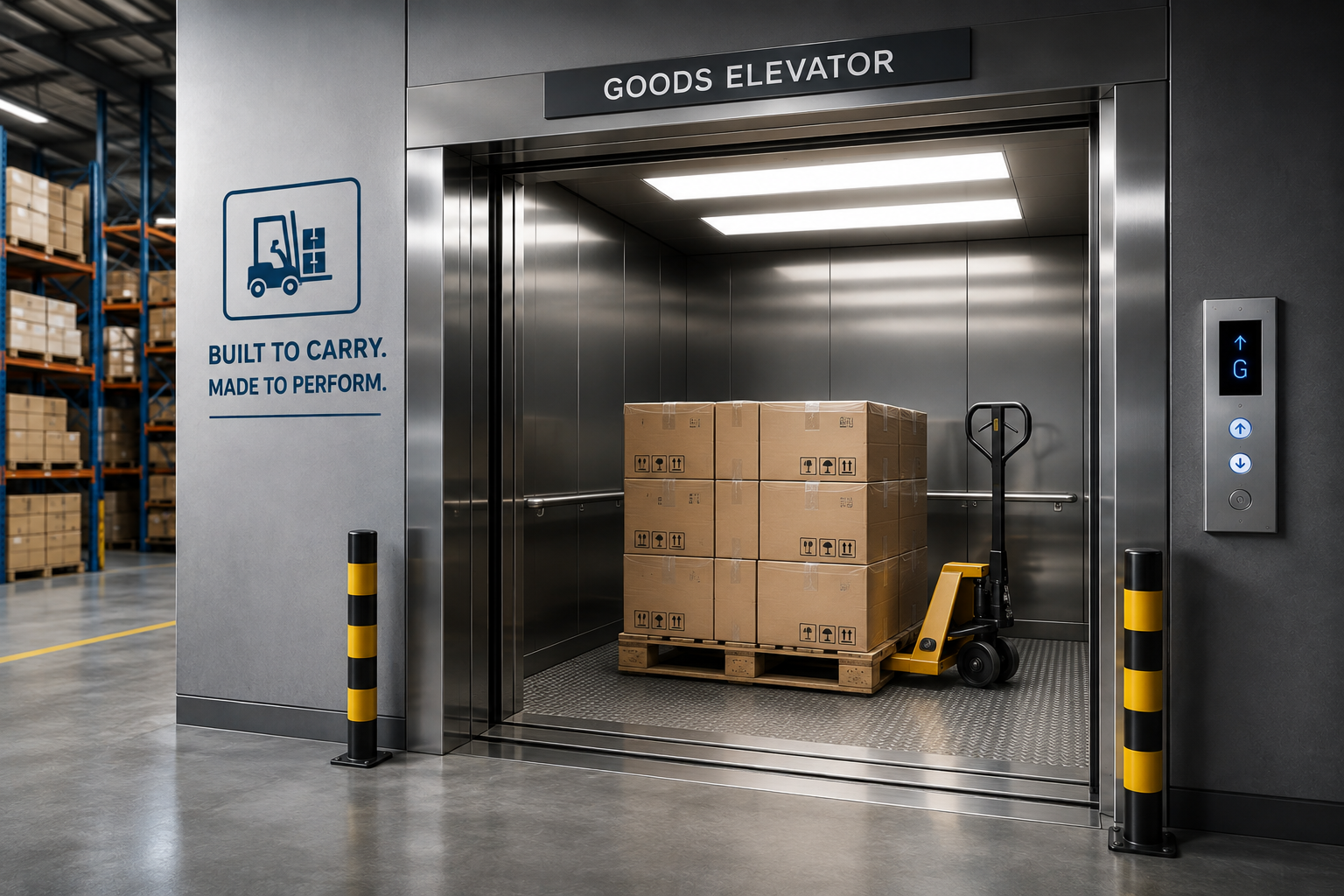
Goods Elevators, also known as Freight Elevators or Cargo Elevators, are heavy-duty vertical transportation systems specifically designed for lifting and transporting goods, raw materials, machinery, equipment, pallets, cartons, warehouse stock, industrial products, and other heavy loads safely and efficiently between different floors. Unlike passenger elevators, goods elevators are engineered to withstand continuous heavy-duty operations and high-capacity load handling while ensuring durability, reliability, and operational efficiency.
Goods elevators are widely used in factories, warehouses, manufacturing plants, logistics centers, shopping malls, supermarkets, pharmaceutical industries, hotels, restaurants, automobile showrooms, hospitals, construction sites, and commercial buildings where the transportation of heavy materials is a daily requirement.
Built with robust structural components, reinforced cabins, advanced control systems, and multiple safety mechanisms, goods elevators provide smooth operation, excellent load stability, and long service life while minimizing manual handling and improving workplace productivity.
Goods elevators operate using either hydraulic or traction drive systems, depending on the building height, lifting capacity, and operational requirements.
In a traction goods elevator, a high-performance electric motor drives a traction sheave connected to steel wire ropes or belts that lift and lower the elevator cabin. A counterweight balances the load, reducing energy consumption and improving efficiency.
In hydraulic goods elevators, a hydraulic power unit pumps oil into a cylinder, pushing a piston upward to raise the elevator platform. When descending, hydraulic fluid is released back into the reservoir through controlled valves, ensuring safe and smooth lowering.
An intelligent microprocessor-based controller manages every movement, providing precise floor leveling, overload protection, automatic door operation, and reliable performance even under demanding industrial conditions.
Goods elevators are built to transport heavy loads safely and efficiently, making them ideal for industrial and commercial applications.
Improved Workplace ProductivityThey reduce manual handling, speed up material movement, and improve workflow efficiency, resulting in increased productivity.
Safe Material TransportationAdvanced safety systems ensure stable movement of goods while protecting both operators and transported materials.
Durable ConstructionManufactured using high-quality steel and premium components, goods elevators are capable of operating continuously under demanding conditions.
Cost-Effective OperationTheir energy-efficient design and low maintenance requirements reduce long-term operating costs.
Flexible InstallationGoods elevators can be customized to suit different building layouts, shaft sizes, and lifting capacities.